
Tales from the Plot, October 2022
With autumn under way October can be a month full of chilly mornings and spooky nights, it’s also a time when we can experience all four seasons in one day. Remember that the clocks go back an hour at the end of this month so grasp every minute of daylight on the allotment that you can before the dark days of winter are upon us.
Every child loves to make a Jack o’ Lantern, so harvest your pumpkins and squashes now. Any that aren’t used for Halloween will make a perfect supper.
Strip outdoor tomatoes and those that are not good enough for the table we usually trim, chop and put them in plastic bags the equivalent to a tin of tomatoes about 400g, these can be frozen and are great throughout the rest of the year just to add to a pizza chilli or a bolognese sauce etc.
Green tomatoes can still be ripened but don’t forget to check on them from time to time! Maincrop potatoes that are in the ground are usually lifted by the end of the month using a potato or garden fork to lift them to prevent damaging the tubers, however I’ve never managed it without stabbing at least half a dozen LOL.
Harvest the last of the runner bean crop for this year and any that have gone over place in a tray and leave to dry out then pop the seeds out and keep in a paper bag for next year – I do this every year and keep french beans, runner beans and peas seeds: there’s no need to buy every year. I remember a plot holder that had a marvellous crop of runner beans year-on-year he told me he hadn’t bought any bean seeds for 20 years!
You should keep harvesting chard, spinach, carrots, celeriac, lettuce and any oriental vegetables.
Some plot holders sow winter lettuce and a couple of short rows of winter hardy peas and broad beans towards the end of the month to provide you with an early crop next spring, although I have to say I’ve never been that successful but I will try with broad beans this year. You can also sow garlic, I have been told you sow garlic on the shortest day and the harvest it on the longest day however last year I planted mine towards the end of October into large 60ltr tubs and had better results than I’d ever managed before so I will be repeating that this year.
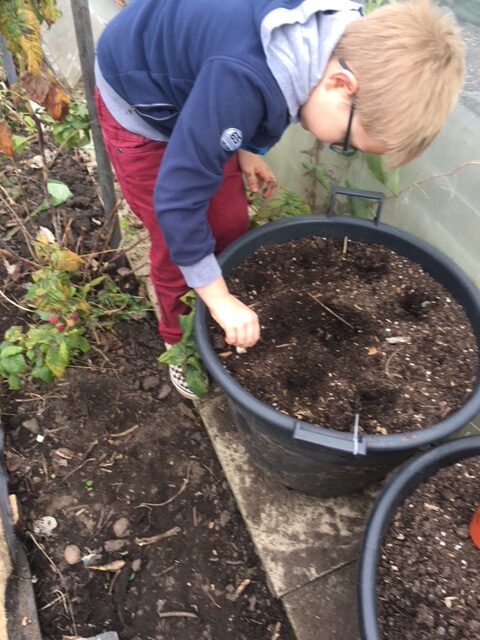 Plant out spring cabbage and overwintering types of onion and garlic, it is also a good time to plant or move rhubarb crowns.
If your ground is heavy rough dig over and leave it in lumps or ridges to be broken down gradually by the winter frosts and rain. We are lucky in Syston our ground is sandy and light, it’s still heavily debated between plot holders as to whether there is a need to winter dig however you need to keep off the soil if it is wet and don’t be tempted to dig it if it is frozen. When the soil is frozen hard it is a good opportunity to cart barrows of manure or compost over it, finding decent manure can be a task. When I first got my allotment I heard stories of a couple of plot holders having some manure delivered from a local farm spreading it over their plots only to find it very difficult to grow certain crops the following season, plants were dying a very short time after planting, it turned out that the farmer sprayed his field to kill a weed that was rampant on his land he knew that it would not cause his cattle any harm however it did pass through them and now it’s been spread over 2 allotments which took several years to fully recover so there is certainly a lesson to be learnt – be careful where your manure comes from.
It’s time to protect the more tender plants using horticultural fleece, the last couple of winters have been quite hard, be prepared to protect chard plants, spinach, winter lettuce, peas, broad beans and any other crops that you are overwintering from the worst of the winter weather. Keep some fleece, plastic or have cloches nearby ready to use.
Clean and clear the plot of spent crops and take down the runner bean poles, cleaning the soil off the bottom of them before storing somewhere cool and airy ready to use next year.
Stake brussels sprouts and sprouting broccoli plants to prevent them from being blown over in strong winds, it is also worthwhile dragging soil up around the base of the plants to give them extra support.
Richard Thorpe 15 B