
Leicestershire & Rutland Wildlife Trust – Brown Hare
Late winter and early spring is the best time to look out for brown hares, when their breeding season brings them out into the open and you may be likely to see them chasing one another in fields and meadows.
Sometimes they look like they are ‘boxing’, when two hares will stand on their hind legs and attack each other with their front paws, giving the impression of two boxers in a ring; this is actually the female hare hitting out at a male hare to ward off his advances!
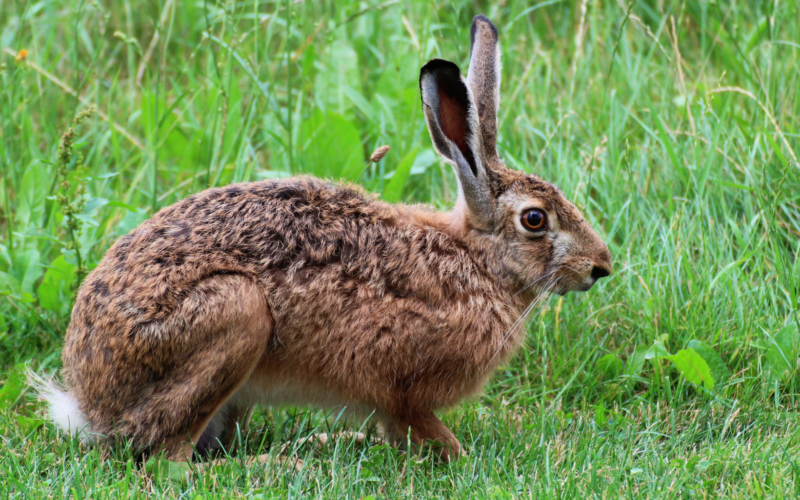
Brown hares are much larger than rabbits, with distinctive large black-tipped ears and long, powerful hind legs. They are a golden brown colour, with a pale belly and white tail. A shy, alert creature, the brown hare is equipped for life in open countryside where cold wind and rain is as much of a challenge to survival as predators. Large eyes, positioned to allow 360-degree field of view, provide the excellent eye sight and hearing it needs to warn off danger. As well as acute senses, the brown hare relies on camouflage, phenomenal powers of acceleration and running speeds of up to 45 mph to evade predators, such as foxes.
Hares live above ground, sheltering in ‘forms’, which are shallow depressions in the grass. They spend most of their day on or near their ‘form’, moving out to feed at dusk and dawn, mainly eating grass shoots and cereal crops. Hares are mostly solitary animals but will sometimes band into loose groups when feeding. During the breeding season, the female can rear up to three or four litters of two to four young known as leverets. During the first four weeks of their life, the mother will feed the leverets once a day at sunset; beyond that, they receive no other parental care.
The brown hare is part of our folklore, its energetic leaping and wild chasing has given rise to sayings such as ‘mad as a March hare’ and ‘hare-brained’, and we all know the character of the March Hare in Lewis Carroll’s Alice in Wonderland. However, they are actually a non-native species; it is thought that they were first introduced to England during Roman times or by people of the Iron Age.
Look out for brown hares at Rutland Water Nature Reserve.
Did you know?
* A male brown hare is called a ‘Jack’ and a female is called a ‘Jill’
* Witches were once thought to have the power to turn into hares to escape their enemies
* In folklore the hare is associated with fertility and the original Easter bunny was actually a hare
Brown Hare numbers have seen a decline in the last 60 years; you can help protect them and other local wildlife by joining your local Wildlife Trust. Leicestershire and Rutland Wildlife Trust is the leading conservation charity in Leicestershire and Rutland working to protect and enhance local wildlife and wild places and engage people with nature. Find out more – www.lrwt.org.uk