Tales from the Plot
Hello, For those expecting Richard’s usual tales from the plot, I’m sorry to report that Richard (Grizz to many) is taking an enforced health break. I’m sure we all sincerely wish him the very best of luck through his sudden serious illness, and for the best of outcomes and the speediest, safe recovery. The allotments don’t feel the same at the moment, without Richard’s daily laughter cheering the air. His shed and friendly company is like the social epicentre of Syston allotments.
This is Kate here, Richard’s 10 year Syston allotment friend and fellow near-neighbour plot holder. I’ve been ‘allotmenting’ since the 1990’s, starting in Derbyshire and have been asked to step in, so I’ll be covering Tales from the Plot for a while, while Richard is sadly not well enough. I hope to hand back to him as soon as we can.
A few of us are helping to look after his plot and chickens along with his family, who’s main focus and priority is rightly on Richard.
At the family’s request, and in accordance with Richard’s mentioned plans last month – not to leave his potatoes in the ground to frosts and spoiling this year, I harvested his many potatoes to give away.
These were distributed to the family. Syston Food Bank at the Methodist church had some, as did a different local community project in Birstall that cooks fresh lunches for elders. St Peter & St Paul’s church had a few for their Harvest Service, as did a neighbour at the allotments (bearing in mind that there are at least 122 plotholder ‘neighbours’ in our allotment community, on the seven acre site). He himself is recovering from two operations and has consequently lost much of his own vegetable produce this season due to being unwell.
And finally, I gave a home to the few that inevitably got inadvertent fork prong damage in the digging. I call these ‘quick chips’ as they would not store long, but after a clean up, are still good for using up quickly.
I made a lazy / hungry / energy saving shepherds pie.. basically I was so hungry after the 3rd session of harvesting, I sped up my cooking by just having mash on top of the veg and mince and didn’t crisp the topping in the oven. It was still very tasty just having faster, softer organic potatoes.
After digging and before covering some of the ground with weed suppressant, I was envious of Richard’s successful potato crop, a bit bigger than my own, but more envious of the healthy abundance of his huge topsoil earthworms that I found, then redistributed to his parsnip patch to over-winter among the root veg. I was observed doing this, by a Robin, who sensibly must have realised the worms were larger than its beak / gape, so didn’t wrestle with them for lunch, just supervised my activities.
Worms are a great sign of soil health. During the winter I don’t entirely clear my ground. I always leave some roots in for worms, beetles and other beneficial soil dwellers. Particularly nitrogen fixing vegetable plants like legumes – peas and beans, as well as companion flowers and Green Manures which also add beneficial shallow roots. I would love to have as many worms as Richard and am slowly increasing them year on year.
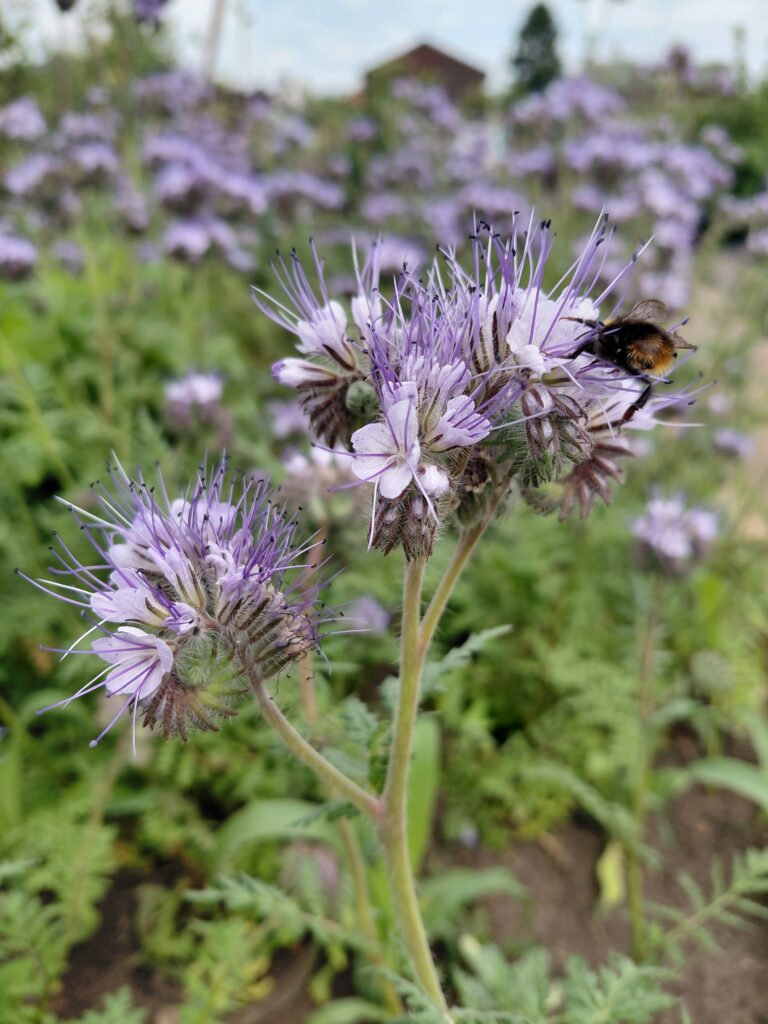
I sometimes use these useful Green Manure plants to cover any bare soil, both in summer and late sowing for early winter. These add nutrients when the ground is resting, or until frosts finish them. They also protect the soil from weeds (I wish I could say 100%). Phacelia, shown right, is my favourite, as bees adore its curly purple flowers, but clovers, mustard, buckwheat are also a fast growing and useful weed suppressant. Ryes and winter vetch are good for winter cover. The intention is that these are all dug in before flowering to nourish the ground, or that’s the theory, if you don’t fall in love with the flowers and leave some for pollinators and allow repeat sowings.
Richard still has a good variety of veggies growing in his ground and netted tunnels. My own crops are now mostly hardy brassicas, open to the elements for over wintering. I love the Tuscan Kale also called Cavalo Nero, Italian, Black, Palm, and Dinosaur Kale –
I particularly like roasting the leaves on a flat tray with a splash of olive oil and salt, just until crispy and easy to crush up into dusty bits (disposing of stem) 15-20 mins approx. An easy addition if you have the oven on for something else. They make a light crunchy, crumbly snack or topping and for kids they are unrecognisable as the healthy vegetables they are, but tasty… sweet and nutty. (less bitter than curly Kale). Serve as Dinosaur crisps!
Kate H, Syston Allotments