
The Miracle of Hearing – But How Do We Actually Hear?
Hearing is something most of us rarely think about until it becomes more difficult. Yet the human auditory system is a remarkably complex and finely tuned anatomy that allows us to detect sound, understand speech and stay connected to the world around us.
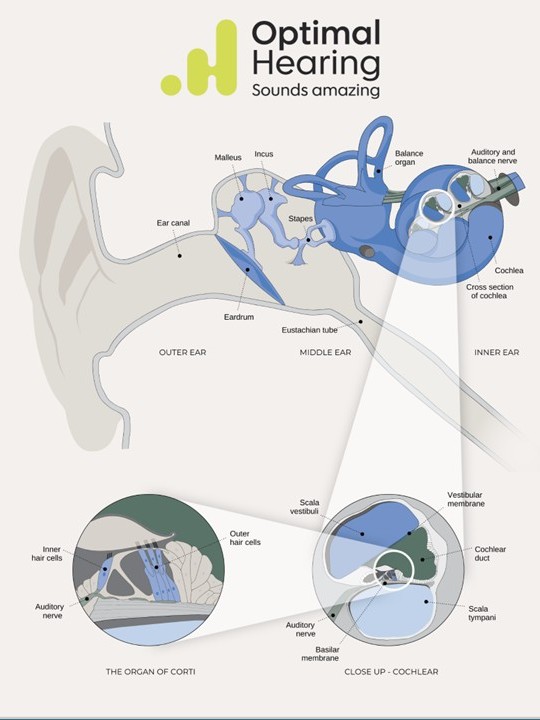
The process begins in the outer ear, the visible part of the ear and the ear canal. These structures act like a funnel, collecting sound waves from the environment, amplifying and directing them towards the eardrum. When sound waves reach the eardrum, they cause it to vibrate.
These vibrations are passed into the middle ear, where three tiny bones – the malleus, incus and stapes – amplify the movement. Despite being the smallest bones in the human body, they play an essential role in strengthening sound vibrations before they enter the inner ear.
From there, sound reaches the inner ear, specifically the cochlea. The cochlea is a small, spiral-shaped structure filled with fluid and lined with thousands of microscopic sensory structures known as stereocilia, often called “Hair cells”. When vibrations enter the cochlea, they create movement in the fluid which stimulates these hair cells. Each hair cell responds to different sound pitches, converting the mechanical vibrations into electrical signals.
These signals then travel along the auditory nerve to the brain, where they are interpreted as meaningful sound. The brain plays a crucial role in hearing – it identifies speech, separates voices from background noise and gives sound its context and meaning.
Typical hearing loss, known as presbycusis, most commonly occurs within the inner ear. Over time, the delicate hair cells inside the cochlea gradually become damaged or lost. Unlike many other cells in the body, these sensory cells do not regenerate once damaged.
This type of hearing loss usually develops slowly and often affects higher frequencies first. As a result, people may still hear that someone is speaking but increasingly struggle to distinguish certain speech sounds, particularly consonants such as “s”, “f” and “t”. Conversations may begin to sound mumbled, muffled or unclear.
Many people first notice this difficulty in social situations or environments with background noise. This happens because the brain must work harder to separate speech from surrounding sounds, and when the auditory system is not providing clear signals, understanding becomes more challenging and tiring.
This is where modern hearing solutions can make a significant difference. Hearing aids do not simply make sounds louder; they are sophisticated digital instruments developed to support the way the auditory system naturally works. They contain sensitive microphones that pick up sound, a tiny computer processor that analyses and re-engineers the sound, performing millions of calculations per second, and tiny speakers that delivers the corrected sound into the ear.
When correctly and accurately fitted, modern hearing aids can accurately amplify the frequencies a person struggles to hear. Many devices also include advanced features that identify and manage background noise and enhance speech, helping the brain receive clearer information and reducing fatigue. In effect, hearing aids compensate for the reduced sensitivity of the damaged hair cells and help restore clarity to everyday listening.
With thorough and accurate assessment, fitting and adjustment, hearing aids greatly improve communication, reduce listening effort and help people remain socially connected. While hearing loss is a common part of ageing, modern hearing technology allows many people to continue enjoying conversations, social occasions and everyday sounds with confidence.
Paul, Dee & Sophie
Optimal Hearing Syston