
Tales From The Plot May 2026
The Emblem flower for May is the Hawthorn, May is known as the month of Fertility / Warmth. There will be two Full Moons on the 1st and 31st May. The one on 1st May is known as either Flower, Hare, Milk, Mothers, Corn planting, Sprouting. While the one on the 31st May is known as the ‘Blue Moon’, not literally blue, but ‘Once in a blue moon’ is the rare timing of when there are two full moons in one calendar month. Timings vary.
Gardeners instinctively learn natural patterns and rhythms of nature that work for growing success. These become 2nd nature as we evolve. It’s not essential to know where the knowledge originates from to succeed, but a nod to ancient times, and our ancestors old habits and beliefs may give us a clue beyond ‘word of mouth’ and modern research. Knowledge of the moons waxing, waning and dates of its phases has long been important in history for being influential for planting times, flavour, patterns, vigour and yield productivity, akin to moon tides ebbing and flowing in the land, as well as the sea. This is as important to some growers as weather conditions. For many of us, biodynamics and lunar cycles, affecting crops is a lost and detailed art/science, yet still, we each know enough of what we need to know from ‘somewhere’ for our successes – and if our instincts work, we don’t have to get complicated about it. We can just trust them and gaze up at our mysterious moon with quiet gratitude (twice this month).
We can also hope that the human endeavours in April’s Artemis ll mission to reach and eventually to perhaps utilise the moon with future science, will not forget the simple ‘integrity’, value and importance of the natural moon.
Now back to earth..
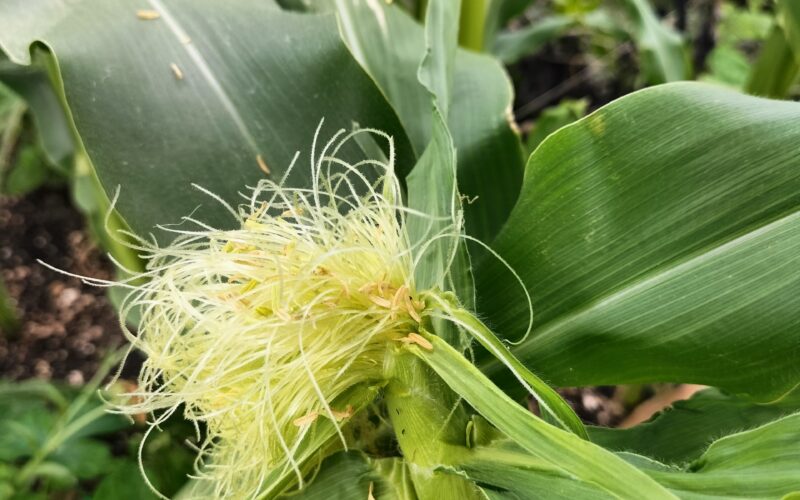
May is a busy month on the plot. I love it because my favourite crop of sweetcorn finally goes in, completing my first round of sowings. I always save a spacious block or gap for the plug plants I buy locally. (12x minimum). Sweetcorn must be grown like this and not in lines, for reasons of maximising air pollination. I enjoy helping the process by hand, ensuring the top drying tassel (with dangling Anther filaments) are distributed throughout emerging green silks of each ear of corn in the block, the silks act like velcro for the tassels and turn brown after pollination – job done.
Richard usually grows his sweetcorn at home from seed of last year’s crops. He puts seed kernals (one per section of a moistened tray) & covers with clingfilm, then progresses them after germination to his cold frame before planting out in May.
In February, I mentioned my comedy parsnips of 2025. Some were ok, but others were finger sized (due to my own health & drought affecting inconsistent watering). As suspected, they are now looking marvellous with fresh, healthy Spring growth, trying to promise me the world ..BUT.. I am proceeding with caution. 2nd year parsnips are not for eating or touching. I want them for flowering for my pollinators, then to harvest their seed for next year, because these plants will have adapted themselves to my growing conditions in our sandy, dry soil at Syston allotments and may hopefully become better suited successes for sowing there. I was recently discussing this plan with Richard. He usefully reminded me that 2nd year parsnip stems become toxic with irritant sap that can affect and discolour skin long-term. So gloves and sleeves must be worn – Who knew? Thanks Richard!
Kate H. Syston Allotments