
The Sounds of Syston in the 1950s and Early 60s, as Remembered by Christine Wilkes
As readers of Syston Town News may recall, Members of Syston History Society are working on a book about our town in the 20th century. Many local people have been kind enough to write some memoirs for us, and this month’s piece is by local woman Chris Wilkes who was brought up on Oxford Street in the 1950s and 60s. Chris describes a rather different way of life from today, when playing football in the street was quite possible as there was so little traffic, and when Syston actually had a greyhound racing track!
Neighbours
All the new houses around us on Oxford Street were homes to young families. All houses had between two and eight children, the average being four. The children seemed to be kept in order and disciplined verbally, as all up and down the street mothers could be heard yelling at their children.
Then there was the evening round-up call. Most children were sent ‘out to play’ after breakfast and were not expected to come in except for meals or to go to the toilet. Towards evening, mothers would stand at their doors and roll-call their children home by calling their names. Our next-door neighbour was particularly good at it – introducing a loud yodel into her children’s names which carried to either end of the street and sometimes as far as Barkby Road if the wind was in the right direction.
Whistling in the street was common then and could be melodious, raucous or downright piercing. Milkmen and painters were particularly given to whistling and singing could often be heard too, particularly from members of The Syston & District Operatic Society. An unpleasant yet satisfying noise could be made by holding a blade of grass between two upright thumbs and blowing hard onto it into cupped hands, and many children were the experts at this.
Disputes between children were usually played out verbally. Consequently there was often a lot of shouting and arguing mixed with shrieks and squeals from the girls and loud howls from any seriously displeased small child. Babies were put outside in their prams for ‘airing’ but I don’t remember much baby crying noise – maybe they were drowned out in the general cacophony.
Very few houses kept a dog; any that there were seemed to be as free-range as the children….. .
Most households kept at least one cat. These were put outside at night – I was never sure why….. Often they would gather in groups in the gardens and set up a yeowling, meowing, howling symphony – seemingly for no other reason than who could make the loudest noise for the longest time.
Bird song was a constant background sound, mostly house sparrows, starlings, blackbirds and thrushes. Some of the neighbours kept flocks of hens – so clucking and cockerel noises were normal background noise too. Cuckoos could be heard in the spring along with small children imitating them.
Vehicles
There weren’t many of these in our area and those that there were on the road were old and well used. Thus they could be heard from two streets away – giving us plenty of time to clear the road of balls, skipping ropes and any piles of coats used as goal posts. Play was quickly resumed after they’d passed! Occasionally a steamroller would rumble slowly and noisily along the road, causing everyone to stop what they were doing and watch it go by.
The Greyhound Racing Track
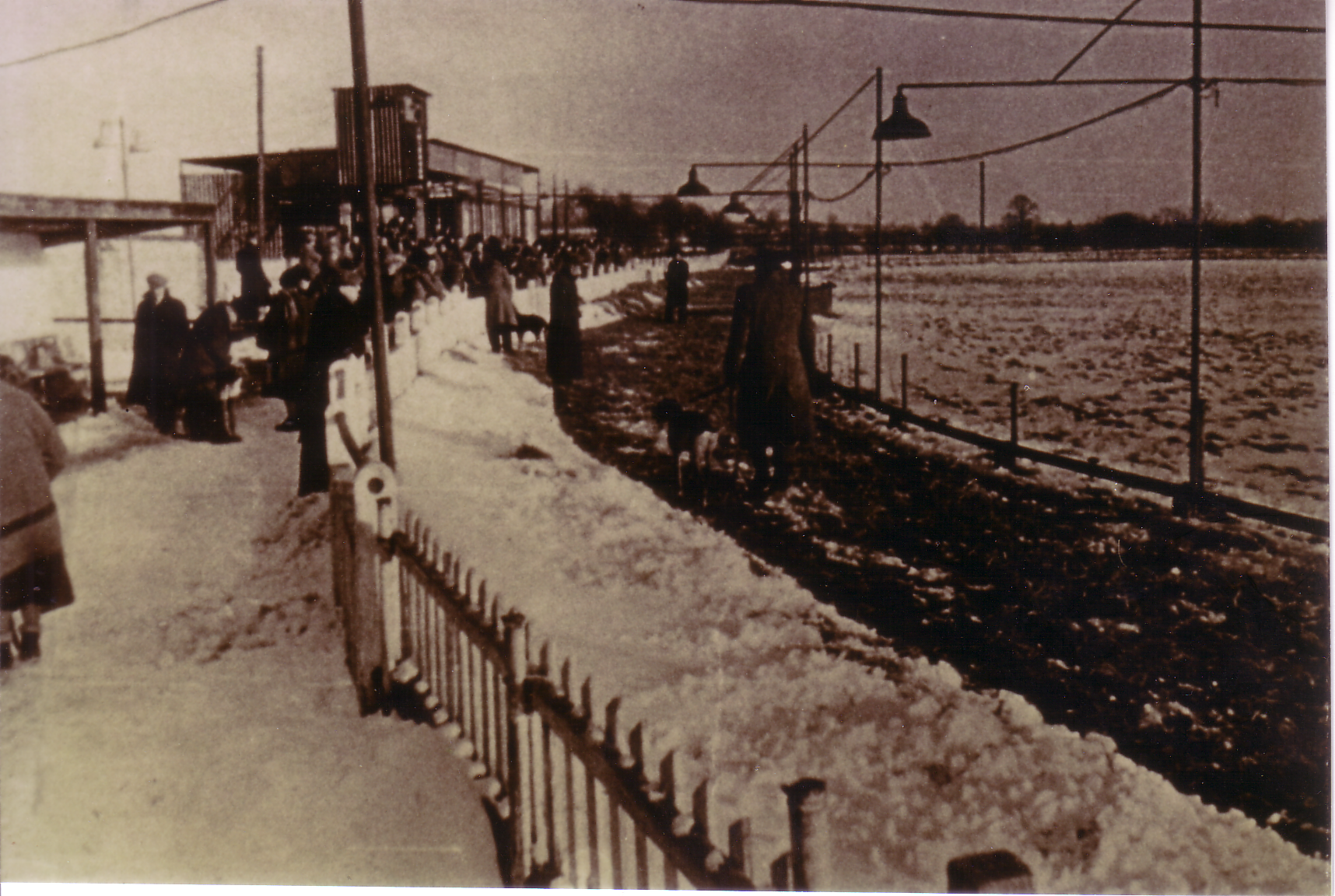
 ‘The dog track’ was on the country side of East Avenue. It was in very regular use – the sound of the mechanical ‘rabbit’ hurtling along its track was a frequently heard sound – along with the cheers of the spectators and some barking from the dogs.
Mr. Gallagher, who lived in the big house at the bottom of Oxford Street, cared for and trained greyhounds. He was usually to be seen several times a day walking his dogs or taking them to and from the track. He walked them about six at a time, all on separate leashes, a bunch of 3 in each hand. They barked quite a lot when in the house but were quiet and well behaved while out.
Herbert’s – The Stone Masons
This was situated on Melton Road near to the village centre of Syston. It was a very busy place and the screech of its mechanical circular saw as it cut through large blocks of stone could be clearly heard all over the north of Syston. In certain climatic conditions the centre of Syston could be covered in a thin film of stone dust.
Church Bells
From Syston church, the hour would be struck during daylight hours; the bells rang for services, weddings, Christmas, New Year, bell ringing practice and tolling solemnly for funerals. Sometimes, depending on wind direction, the bells of Barkby or Wanlip churches could be heard.
Fire Siren
Syston Fire Station in the 50s was manned by local volunteers. When they were needed, a siren on top of Eatough’s factory would be sounded. This siren was left over from World War Two – the old ‘all clear’ signal, which had originally indicated the end of an air raid, was used. This started as a very low pitched note, quickly rising to a high horn-like sound, running for about 2-3 minutes before subsiding into a low growl again. When it sounded, the local volunteer firemen would stop whatever they were doing and get to the Fire Station as quickly as possible, even if they were at work.
The Railway
Most noticeable noise from the railway was the ‘shunting’, often done at night. The shunting yard was on the village side of the central platform. This was a means of moving the goods wagons from one line to others or transferring them from one engine to another. First there would be the chugga chugga chugga of the steam train getting into position – then a ‘bonk’, quickly followed by a series of ‘clanks’ as each wagon’s metal buffers hit the next wagon in the line. This could go on for quite a while.
Another sound, still with us occasionally more than fifty years later, is the loud squeaking noise coming from goods wagons as they negotiate the sharp bend in the line near High Street.
Blasting
These noises emanated from Mountsorrel Quarry. This was a loud boom usually heard around midday. An acceptable explosion which did not cause concern to locals, but may have done to newcomers or visitors to the village.
Rook Shooting
The sound of gun-shots from Barkby in the Autumn was normal at the time.
Ice Cream Vans
A welcome sound! There were three vans that came round regularly. Eric’s sold a soft white ice-cream that quickly melted and ran over your hands and clothes.
Lyon’s Maid – my favourite – was a solid, creamy ice-cream, sold in drum shape or oblong blocks.
Wall’s was a solid ice-cream but whiter and less tasty than Lyon’s.
Rag ‘n Bone Men
These came round very regularly with horse and cart. I well remember the horses’ hooves clip-clopping on the concrete road and the loud shout of ‘ennyolragnbone’. They seemed to accept anything, so any items we didn’t want that couldn’t be burnt or put in the dustbin were thrown up onto the cart.