Excuse me…Hidden Challenges of Hearing in Social Settings
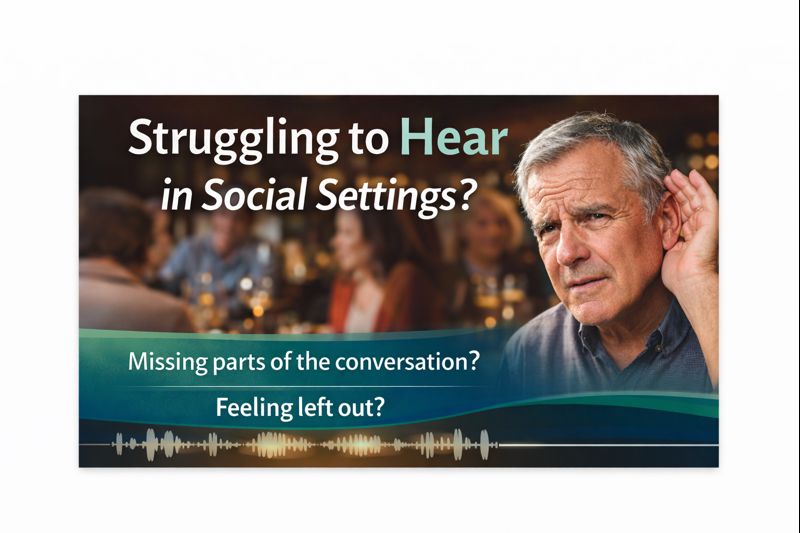
For many people, hearing does not suddenly decline. Instead, it gradually loses sharpness and is often first noticed not in quieter moments, but during busy, social occasions. For some, the recent Christmas period may have highlighted this — lively family gatherings, festive meals, and crowded rooms bringing unexpected difficulty in following conversations that once felt effortless.
This is a common feature of typical age-related hearing loss, also known as presbycusis. In its early stages, hearing loss is often mild and easy to dismiss. People may hear well in quiet environments but struggle when background noise is present. Voices can blur together around the dinner table, and certain sounds — particularly higher-pitched consonants such as “s”, “f” and “t” — become harder to distinguish. Speech is still heard, but parts of it are missed, leading to frequent requests for repetition or subtle misunderstandings.
As hearing loss progresses from mild to moderate, social situations can become increasingly tiring. The brain works harder to separate speech from background noise, whether that is music playing, multiple conversations, or the general bustle of a busy room. Many people notice this most after social events, feeling mentally drained or irritable without quite knowing why. Some may begin to step back slightly — choosing quieter corners, contributing less to group conversation, or avoiding social events altogether.
With more significant hearing loss, the impact on social life increases. Group conversations may feel overwhelming, particularly in echoing spaces or environments where sound levels rise when everyone is together. Lip-reading often becomes an unconscious coping strategy, and when visual cues are limited, understanding can drop sharply. It is not unusual for people to feel isolated even when surrounded by family and friends, which can affect confidence, mood, and enjoyment of everyday life.
There are around 6.7 million people in the UK who would benefit from some help with their hearing. Despite how common hearing difficulties are, our ears are frequently neglected. Unlike eyesight or dental care, hearing often relies on personal proactivity — many people wait until difficulties become impossible to ignore before seeking help. In reality, hearing should be monitored regularly. As a general guideline, adults over the age of 60 should have their hearing checked every two years, or sooner if any concerns arise. Regular monitoring allows changes to be identified early, when intervention is often simpler and more effective.
At Optimal Hearing in Syston, we regularly see how hearing issues affect far more than hearing alone. They influence relationships, independence, confidence and emotional wellbeing. Many visitors have had hearing aids fitted previously but are still not hearing to their full potential. The positive news is that hearing care has advanced enormously. Modern hearing technologies, when chosen and fitted accurately, can improve speech clarity dramatically, manage intrusion from background noise, and adapt to different listening environments — including the very social situations many people find most challenging.
Hearing loss should never be dismissed as “just part of getting older”. The Christmas period often serves as a timely reminder of how important clear communication is to feeling connected. Early assessment and personalised support can make a lasting difference, helping people remain confident, engaged, and socially active.
If conversations felt harder than usual over the festive season, it may be time to have your hearing checked. Clearer hearing supports clearer connections — at Christmas and all year round.
Paul, Dee & Sophie
Optimal Hearing Syston